
We are working on a long text document, scrolling for several minutes, and we want to return to the very beginning. The common reflex is to spin the mouse wheel or hold down the up arrow key. The Home key, discreet on the navigation pad of the AZERTY keyboard, solves this problem in a fraction of a second. Its role doesn’t stop there, and most of its combinations remain underutilized in daily use.
Home Key on AZERTY Keyboard: Different Behavior Depending on the Software
The first point to understand is that the Home key does not have a unique behavior. What it does depends on the active application, the operating system, and even the terminal emulator used.
In a word processor like Microsoft Word or LibreOffice Writer, pressing Home brings the cursor to the beginning of the current line. Combined with Ctrl, it sends the cursor to the very top of the document. In a browser like Chrome or Firefox, Home scrolls the page to the top, without any notion of a text cursor.
In a Bash terminal, the situation changes again. The key is interpreted by GNU Readline as the beginning-of-line command, which moves the cursor to the beginning of the current command line, not to the beginning of the history. This distinction is crucial when typing long commands and wanting to correct the first argument without erasing everything.
When exploring the functions of the home key on AZERTY keyboard, we realize how much the software context changes everything.
Keyboard Shortcuts with Home on Windows: Quick Selection and Navigation
The real power of Home appears in its combinations. On Windows, three shortcuts are worth remembering for all users who regularly handle text.
- Shift + Home selects all the text between the cursor position and the beginning of the line. Useful for deleting or reformatting the start of a sentence without touching the mouse.
- Ctrl + Home brings the cursor to the very beginning of the document. In an Excel spreadsheet, this combination returns to cell A1, regardless of where you are in the sheet.
- Ctrl + Shift + Home selects all the content between the current cursor position and the beginning of the document. It is used to delete an entire block upstream or to apply global formatting.
These three combinations work in the vast majority of Windows applications: text editors, spreadsheets, email clients, web form input fields. Feedback varies on this point depending on specialized software (some development IDEs redefine these shortcuts), but the standard behavior remains reliable in the common office environment.

Home Key on Mac: The Fn + Left Arrow Combination
On a portable Mac keyboard, the Home key does not physically exist. Apple has chosen to minimize the number of keys. To replicate the behavior of Home, you use Fn + Left Arrow.
This detail poses a real problem for users who regularly switch from a Windows computer to a Mac. The muscle memory acquired on a standard AZERTY keyboard no longer works. And the combination Fn + Left Arrow is not always documented visibly in the macOS system preferences.
The same principle applies to other keys on the navigation pad: Fn + Right Arrow replaces End, Fn + Up Arrow replaces Page Up, and Fn + Down Arrow replaces Page Down. When connecting an external USB or Bluetooth keyboard that has these physical keys, they work natively under macOS without additional configuration.
Home in a Terminal: Beware of Escape Sequences
This is a case that most guides ignore, and it directly concerns developers and system administrators. Home may stop working in a terminal multiplexer like Tmux.
The problem does not come from the keyboard. It comes from the escape sequences that the terminal sends to the system. Depending on the emulator used, the Home key may generate different codes: ESC [ 1 ~, ESC [ H, or ESC O H. If Bash or Readline does not recognize the received sequence, the result is the insertion of garbage characters (often a tilde) instead of the expected movement.
The solution involves configuring the .tmux.conf or .inputrc file to explicitly map the correct sequence. Here we touch on several stacked software layers: the physical keyboard, the system driver, the terminal emulator, the multiplexer, and the running application. Two identical AZERTY keyboards can produce different results in Bash, Tmux, or Vim because each environment interprets the codes in its own way.
Home Key Missing or Malfunctioning: Alternatives on Compact Keyboards
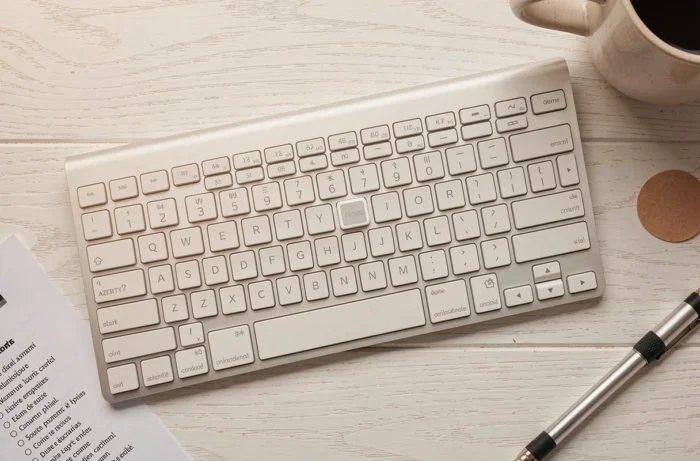
Compact keyboards, especially models without a numeric keypad, sometimes eliminate the navigation pad to save space. The Home key then physically disappears.
On these keyboards, the manufacturer typically assigns Home to a combination via the Fn key, often Fn + a key from the top row. The labeling varies by brand and model, making it somewhat unintuitive at first.
- On a standard compact keyboard, check the manual or the manufacturer’s configuration software to identify the corresponding Fn combination.
- On Windows, Microsoft’s PowerToys remapping tool allows you to reassign any key to simulate Home on an unused key.
- On programmable mechanical keyboards, the Home key can be placed on a custom layer accessible via firmware like QMK or VIA.
If the key physically exists but no longer responds, the problem is rarely hardware-related. A restart or checking the keyboard language settings in Windows is sufficient in most cases. A keyboard mistakenly configured as QWERTY can alter the behavior of certain navigation keys, even if the physical layout remains AZERTY.
The Home key remains one of the fastest navigation shortcuts on a keyboard, provided you know its actual behavior in each context. Between word processing, the terminal, and the browser, its effects change, and it is precisely this versatility that makes it useful once mastered.