The displayed price for a duplicate key represents only a fraction of the actual cost. Between the provision of the blank, the cutting, potential programming, and additional fees, the discrepancies between two quotes can exceed simple doubling for identical services. Here, we detail the technical checkpoints that allow for effective price comparison in 2024.
Breakdown of the key duplication quote: hidden costs
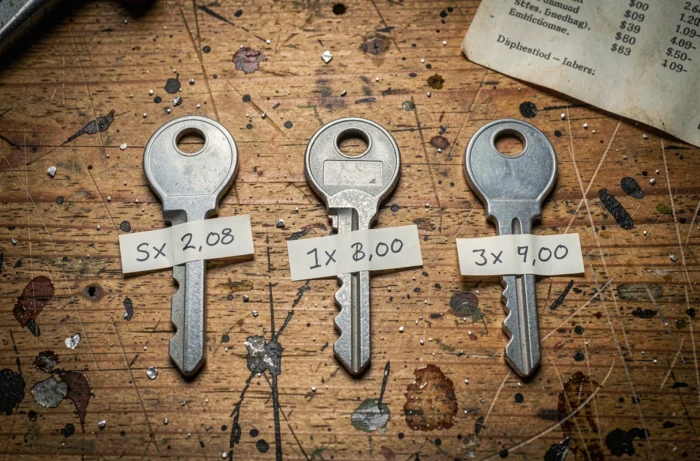
An advertised “all-inclusive” rate is almost never truly comprehensive. The first check is to identify whether the price includes the provision of the blank and the cutting. Some providers charge for the blank separately, which skews any direct comparison.
The decree of January 24, 2017, requires locksmiths to communicate the all-inclusive hourly rate, the method of time calculation, any flat fees, and travel expenses before any execution. This obligation applies even in emergencies. Requesting a detailed quote is not a precaution; it is a right.
For workshop duplication, we recommend checking five distinct lines on the quote:
- The price of the blank (varies according to the key profile and the cylinder brand)
- The cost of the actual cutting, sometimes flat-rated, sometimes charged by time spent
- Electronic programming if applicable (transponder key, badge)
- Shipping costs if the order goes through the manufacturer
- Any surcharges for work outside of hours or in emergencies
A quote that groups everything into a single line prevents any serious comparison. Before going further, it is useful to compare prices on Dépannage Serrurier 92 to have a reliable pricing reference.

Patented key and ownership card: the direct impact on duplication pricing
The presence of an active patent on the key profile radically changes the reproduction circuit. As long as the patent is in effect, only the manufacturer’s authorized network can provide the blank. An independent locksmith cannot cut this key, even if they have the appropriate machine.
The ownership card serves as proof of authorization. Without it, reproduction is refused, and resorting to the manufacturer involves a delay of several days to a few weeks depending on the brand. This delay has an indirect cost that is rarely included in comparisons: it makes low-cost emergency solutions impossible.
Check the patent expiration date
A locksmith patent generally lasts about ten years. After this period, the blank becomes free for reproduction and any equipped locksmith can cut it. The price then drops significantly.
We observe that many individuals are unaware of this point. Before requesting a quote, checking the patent number on the ownership card allows one to know if the key is still protected. A serious locksmith will verify this information; others will charge the “patent” rate without verification.
Duplicating a transponder car key: auto locksmith or dealer
Modern vehicle keys incorporate an electronic chip (transponder) that communicates with the vehicle’s immobilizer. Duplication is not limited to copying a mechanical profile: it is also necessary to program the transponder to be recognized by the computer.
The car dealer systematically offers this service, but at a high price that includes the manufacturer’s markup on the part and labor. A specialized auto locksmith, equipped with a compatible programming machine, performs the same operation at a significantly lower cost.
Comparison points between dealer and auto locksmith
The price difference between these two channels can reach several tens of percent. To compare effectively, one should ask each to detail:
- The price of the blank key with transponder (original or compatible part)
- The cost of the software programming on the vehicle
- The availability time of the blank (in stock or order)
An auto locksmith often uses compatible blanks rather than original parts. The reliability is comparable, but the supply price decreases. Ensure that the programming is tested on the vehicle before paying: a cut key that is not recognized by the computer is unusable.
Duplicating a building badge: technical limits to know
Vigik-type badges operate on a system of temporary access rights recharged by operators (La Poste, emergency services). Physically duplicating the support is not enough: the copied badge loses its rights as soon as the encryption keys rotate.
Online or in-store duplication services offer to clone the contents of the badge onto a new support. The result works temporarily, but the copy will be invalidated during the next system update. Comparing badge duplication prices without considering this limited lifespan amounts to comparing services of different natures.
The sustainable solution remains to request an additional badge from the property manager or landlord, who will have it programmed into the system. The cost is sometimes higher, but the badge remains functional indefinitely.
Avoid overcharging in emergency repairs
Replacing a lock is not automatically necessary when a key is lost or broken. Before accepting a repair quote, we recommend explicitly asking why a simple duplication, extraction of a broken key, or replacement of just the cylinder would not suffice.
Some repairmen charge for a complete lock change when a new cylinder resolves the issue. The cost of a cylinder alone is much lower than replacing the entire lock. Asking the question steers the quote towards the service that is actually needed.
Comparing duplicate key prices in 2024 requires reasoning in total cost: blank, cutting, programming, time frame, longevity. The face value of a duplication does not convey much until the quote details each item. Keeping the decree of January 24, 2017 in mind during any request is enough to filter providers who practice transparency from those who do not.