
One can spend years drawing impeccable silhouettes without ever crossing the invisible boundary that separates the still image from living movement. This leap, far from being a simple extension of acquired skills, even destabilizes the most seasoned artists. Anatomy, proportions, the accuracy of the line: all of this wavers as soon as it comes to animating, to giving breath to the line.
As one confronts animation, flaws appear, sometimes where they are least expected. Managing rhythm, the ability to simplify without betraying intent, anticipating distortions: these are gray areas rarely addressed in traditional training. Yet, methods exist to navigate these stages without exhausting oneself or doubting at every panel. For those seeking a solid foundation, here are the steps to learn animation.
Why transitioning from static drawing to animation changes your perspective on the human body
Changing disciplines disrupts the way one perceives things. The line, previously a sign of confidence, becomes the main tool to translate energy, the inner dynamics of a movement, the tension of a gesture being constructed. A sketch is no longer enough: one must grasp the logic of moving from one pose to the next, capturing the transition on the fly.
In the studio, the exercise of life drawing takes on a new turn. Gone is the faithful reproduction of a posture: what matters is understanding what connects, drives, and tips each position. Classes and groups train to detect the underlying intentions behind each movement, focusing on the essentials rather than lingering on decorative details.
Teaching tools evolve with ambition. Studies inspired by cinema, sequential analysis frame by frame, attention to the silent details of gestures: these approaches take place in workshops, gradually transforming the learning method. Learning to anticipate transitions, to extract the intent of a posture, to condense expression without diluting it in minutiae, these steps mark the journey of those who take the plunge, from Paris to Lyon, passing through all the schools that reject ready-made recipes.
What obstacles do manga artists face when they venture into animation?
Manga artists quickly encounter new challenges. Mastery of the line, so reassuring in a static image, takes on another dimension when it comes to bringing the whole to life. One must then cut, plan, accept that expressiveness takes precedence over clarity, and rework their relationship with the unexpected.
The graphic tablet and its software, while essential, require a reset of certain habits: organizing layers, adjusting stylus pressure, finding visual comfort between hand and screen, taming interfaces that are sometimes far removed from the world of traditional drawing. The exercise often becomes a test of patience rather than a simple software learning experience.
Social media also weighs in: expectations for responsiveness, demands for speed, immediate feedback on every creation. Many young artists recount how they must juggle execution quality, production speed, and fidelity to their own intent. Transitioning from a simple panel to a complete sequence, without losing track of their ideas or sacrificing the vitality of the gesture, is a true feat.
To face these challenges, several practices prove effective throughout the journey:
- Take the time to familiarize oneself with the main animation software from the start, to prevent many blockages.
- Establish self-evaluation tools such as personal critique grids, which allow for better tracking of progress.
- Adapt the principles of drawing on paper to animation: enhance the readability of movement, simplify volumes, find the technique that fits each sequence.
The collective often plays a key role. Animation workshops become spaces where advice, failures, and discoveries are exchanged, creating a stimulating mutual support to surpass what years of drawing had never revealed.
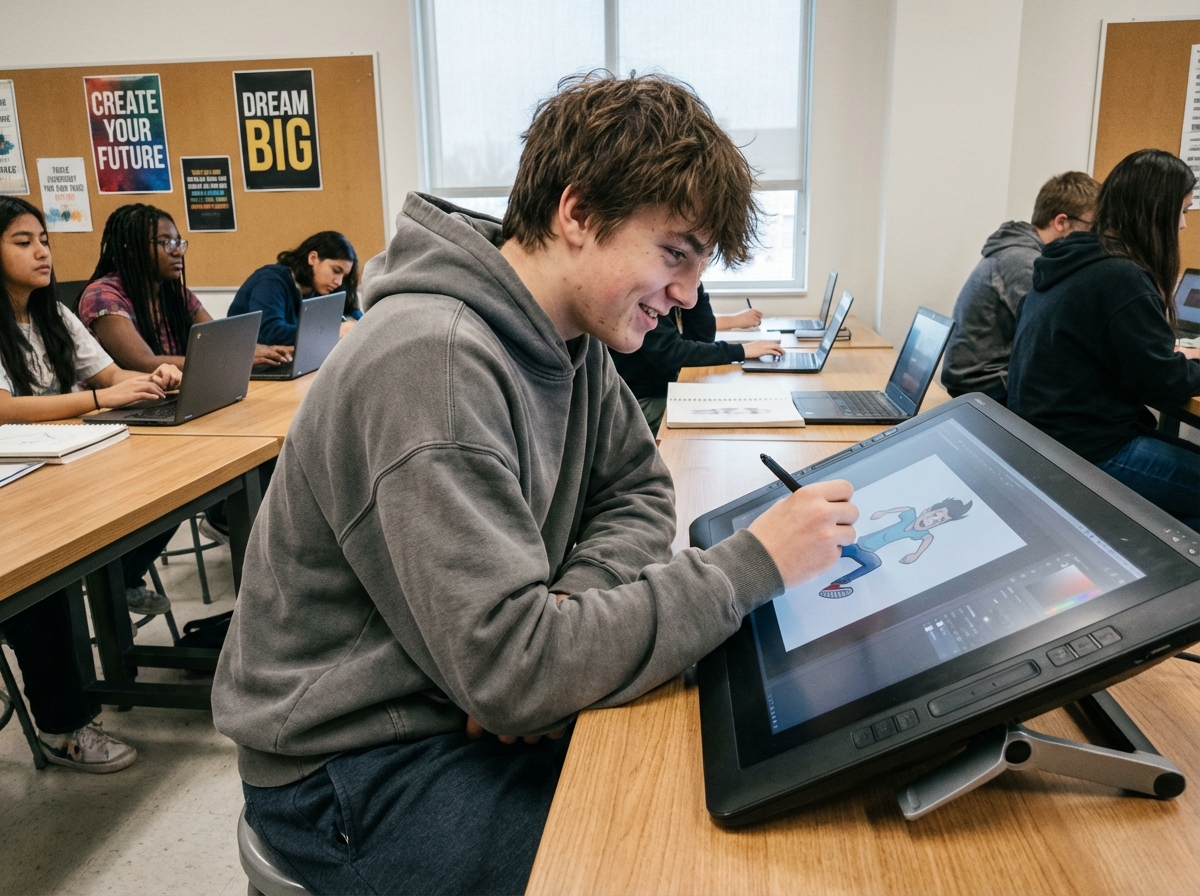
Key steps and practical tips for animating your characters smoothly and making progress
Learning animation means questioning one’s habits. The gesture becomes more precise, the understanding of movement deepens, each new panel demands a renewed perspective. In Paris, in school or remotely, progress is structured around organized steps, adapted to each individual’s pace.
Before any animation, one must establish the line of action, the true backbone of movement. This initial line prevents stiffness, sets the tone, and concentrates intent. A clear sketch, free from unnecessary details, is enough to capture the essence of the character in motion.
From there, it becomes less relevant to aim for formal perfection than to focus on the coherence of the sequence. It is better to work in short loops, concentrating on the fluidity of transitions rather than excessive refinement of the line. Reducing, clarifying, sometimes exaggerating without falling into artifice, this is what gives flavor to each scene created.
A few good habits can help maintain consistent progress:
- Use live models whenever possible to observe anatomy in motion, not just in fixed posture.
- Build personal or collective evaluation grids to guide self-critique without discouragement.
- Switch between individual creation time and collective projects, multiplying feedback and discussions to enrich one’s critical perspective.
Exploring digital tools also takes its place: testing different tablets, comparing software features, gathering feedback on one’s trials in groups, all contribute to strengthening both technique and confidence. By moving forward in this way, through questioning, exchanges, and discoveries, drawing gradually opens up to the promises of animated images and leads the artist tracing them toward unsuspected territories.