A former colleague, six months after his farewell party, admitted to spending his days between the couch and the television. Three kilos heavier, a low mood, and a fall down the stairs that could have ended badly.
This scenario is not exceptional: the transition to retirement after 60 redistributes physical and mental markers in just a few weeks. Preserving health in retirement is not about a list of good resolutions, but about concrete choices adapted to one’s real daily life.
Fall Prevention After 60: The Underestimated Risk
We often talk about diet or daily walking. We talk much less about the first concrete danger that threatens autonomy: falls at home. Recent public health programs now place fall prevention at the center of their recommendations for seniors, with particular attention to evaluating housing, balance, and muscle strength.
In practical terms, this involves simple but rarely applied actions. Securing rugs to the floor or removing them. Installing grab bars in the bathroom. Checking the lighting in hallways and staircases, especially at night. These adjustments may seem trivial, but they significantly reduce the risk of hip fractures, an injury that can permanently compromise mobility.
Beyond housing, one can work on balance daily. Standing on one foot while brushing teeth, climbing stairs without holding onto the railing (when capable), practicing ankle bends every morning. For those who wish to discover the Santé 365 seniors website, dedicated resources help identify exercises suited to each situation.
Adapted Physical Activity: Moving Beyond Uniform Recommendations
Telling someone with knee osteoarthritis to “walk for 30 minutes a day” is akin to giving them an impractical piece of advice. Recent approaches emphasize a point that traditional guides overlook: adapted physical activity is prescribed according to abilities and pathologies, not according to a one-size-fits-all standard.
A former athlete of 62 in good shape does not have the same needs as a 70-year-old on treatment for hypertension. Targeted muscle strengthening exercises (thighs, calves, deep abdominals) protect joints and maintain muscle mass, which naturally declines with age.
Some concrete suggestions based on situations:
- Knee or hip joint pain: prioritize swimming, aqua aerobics, or stationary biking, which engage muscles without impacting joints
- Shortness of breath during exertion: start with short sessions of Nordic walking, gradually increasing the duration over several weeks
- Balance issues: tai chi or specific workshops offered by certain pension funds progressively work on proprioception
- Good overall fitness: hiking, road biking, or ballroom dancing combine cardiovascular effort with social enjoyment
Feedback varies on this point, but support from a professional (physiotherapist, adapted physical activity educator) often makes the difference between a sustainable program and giving up after three weeks.
Social Isolation and Cognitive Health: Two Linked Issues
Mental health and physical health are often seen as separate. Recent data shows that social isolation accelerates cognitive decline comparably to certain medical risk factors. Losing work colleagues, seeing children less often, reducing outings: retirement can create a subtle vicious cycle.
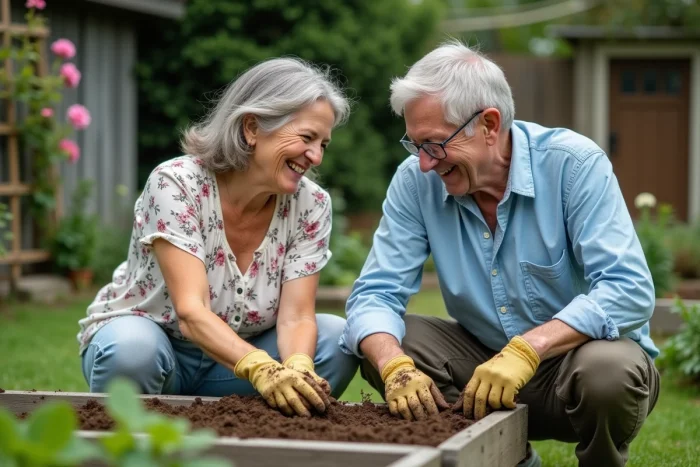
Intellectual stimulation is not limited to crossword puzzles. Learning a language, taking an online course, joining a local association, participating in a repair or community gardening workshop: these activities combine mental effort and human contact. The benefit is twofold.
A rarely discussed point: the regularity of social connections matters more than their quantity. Seeing a friend each week to walk together provides more than a large family meal every three months. Structuring one’s week around fixed appointments (classes, volunteering, market) creates a rhythm that replaces that of work.
Adapting One’s Home to Stay Safe at Home
Staying at home is the majority wish of people over 60. But remaining at home without adapting one’s environment is to ignore the evolution of one’s capabilities. Beyond the grab bars already mentioned, a few modifications make a difference:
- Replacing the bathtub with a walk-in shower with a fold-down seat
- Installing light switches accessible without bending down or raising one’s arm above shoulder height
- Storing everyday items (dishes, clothes) at arm’s reach, between waist and shoulder height
These modifications do not all cost a lot, and some financial assistance is available through pension funds or local authorities. Anticipating these works before an accident necessitates them radically changes the situation.
Personalized Medical Follow-Up After 60: What Really Changes
Medical follow-up after 60 is not limited to an annual blood test. Recent recommendations emphasize a holistic approach that assesses functional capabilities: vision, hearing, balance, memory, nutritional status. The ICOPE program, supported by the World Health Organization and promoted in France, offers exactly this type of integrated assessment.
A often overlooked point: the regular review of medication treatments. With age, one sometimes accumulates prescriptions that interact with each other or whose dosages are no longer appropriate. Requesting a complete review of one’s prescription from a doctor at least once a year prevents unnoticed side effects (dizziness, drowsiness, loss of appetite).
Hearing deserves special attention. Uncorrected hearing loss socially isolates and contributes to cognitive decline. Having one’s hearing tested every two years after 60, even without apparent discomfort, allows for early intervention.
Living well in retirement after 60 relies less on grand principles than on precise, repeated adjustments tailored to one’s own situation. A safe home, calibrated physical activity, regular social connections, and medical follow-up that does not settle for the minimum: these practical details preserve autonomy over time.