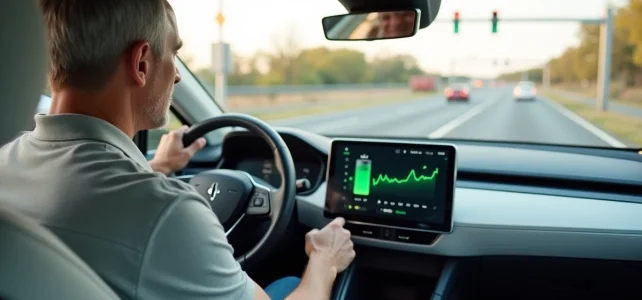
A hybrid vehicle on the highway operates almost exclusively on its thermal engine. At a stabilized speed above 110 km/h, the electric motor no longer has sufficient power to ensure propulsion on its own, and the battery only recovers energy during deceleration phases. Understanding this basic operation allows for adapting driving behavior to reduce fuel consumption, even on long highway trips.
Operation of the hybrid system at high speed
On open roads or in the city, the electric motor of a hybrid vehicle regularly takes over from the thermal engine. On the highway, the situation changes radically. Aerodynamic resistance increases non-linearly with speed: beyond 120 km/h, the effort required from the thermal engine increases significantly.
The electric motor then mainly assists during accelerations (overtaking, resuming speed after a construction zone). The battery, which has a low capacity in a conventional hybrid (non-rechargeable), only recharges through kinetic energy recovery during braking and deceleration. On the highway, these phases are rare, which limits the natural recharging of the battery.
To deepen the strategies of hybrid driving on the highway with Pendant ce Temps, the logic is based on a simple principle: reduce the demand on the thermal engine as much as possible and multiply the micro-phases of energy recovery.
Speed regulator on the highway: a false friend in hybrid
The speed regulator is often presented as a fuel-saving tool. In a hybrid vehicle, its usefulness is more nuanced.
On flat terrain, the regulator maintains a constant speed and avoids unintentional accelerations. As soon as the terrain varies, it becomes counterproductive. Climbing, it pushes the thermal engine to full load to maintain the set speed. Descending, it does not allow the vehicle to take advantage of the natural momentum to recover energy.
An attentive driver will do better by accepting to lose a few km/h on climbs and letting gravity assist on descents. This micro-variation in speed (around five to ten km/h around cruising speed) does not noticeably affect travel time, but it allows the hybrid system to operate within its optimal efficiency ranges.
When the regulator remains useful
On long, perfectly flat sections (some highway segments in northern France, for example), the regulator prevents the temptation to accelerate gradually without realizing it. The ideal remains the adaptive cruise control, which adjusts speed according to traffic and generates deceleration phases that can be utilized by the recovery system.
Reducing aerodynamic and mechanical resistance
Fuel consumption on the highway largely depends on factors that the driver can control even before getting behind the wheel.
- Tire pressure should be checked when cold and set to the high value recommended by the manufacturer. Under-inflated tires increase rolling resistance and force the thermal engine to work harder.
- Roof bars and roof boxes, even when empty, alter the vehicle’s aerodynamic profile. Removing them when not in use significantly reduces drag at highway speeds.
- Air conditioning puts a strain on the compressor (often electric in a hybrid), which drains the battery and pushes the thermal engine to compensate. Pre-conditioning the vehicle before departure and setting a reasonable temperature limits this parasitic consumption.
Every source of resistance eliminated frees up energy that the hybrid system can reallocate to electric propulsion during acceleration phases.

Stabilized speed: the most effective lever
Lowering cruising speed remains the most directly effective measure on the consumption of a hybrid on the highway. Driving at 120 km/h instead of 130 km/h significantly reduces aerodynamic resistance, as this resistance increases with the square of speed.
On a 300 km journey, the difference in arrival time between 130 km/h and 120 km/h is measured in minutes. The reduction in consumption can reach several tenths of a liter per hundred kilometers.
Conventional hybrid or plug-in hybrid: a difference in strategy
In a non-rechargeable hybrid (like the Toyota Corolla or Honda Civic), all electric energy comes from recovery. The strategy focuses on smooth driving and speed reduction.
In a plug-in hybrid, the larger battery theoretically allows for driving in pure electric mode. On the highway, this electric range quickly diminishes due to high speeds.
The real advantage of a plug-in hybrid on the highway remains limited if the battery is not regularly recharged during stops. Feedback from drivers confirms that actual consumption at high speeds approaches that of a conventional thermal vehicle when the battery is empty.
Anticipating traffic and terrain to maximize energy recovery
The electric motor of a hybrid recovers energy during each deceleration. On the highway, these opportunities are less frequent than in the city, but they do exist.
- Letting off the accelerator several hundred meters before a toll area, a slowdown, or an exit allows for progressive recovery, which is more effective than late braking.
- Before a descent, releasing the accelerator early allows the vehicle to decelerate naturally while recharging the battery.
- In heavy traffic, maintaining a sufficient distance from the preceding vehicle avoids successive hard acceleration-braking sequences, which waste kinetic energy.
The ECO mode, available on most hybrids, softens the accelerator response and limits the maximum power of the thermal engine. On the highway, it mainly helps to smooth out accelerations after a slowdown without noticeable loss of comfort.
Vehicle maintenance also plays a role that is often underestimated. A clogged air filter, degraded engine oil, or unevenly worn tires increase fuel consumption, regardless of the type of engine. In a hybrid, these basic mechanical parameters condition the system’s ability to switch effectively between the thermal engine and the electric motor.