
Five liters of punch are prepared the day before a party, the fridge is already full, and the jug stays on the countertop all night. The next day, one wonders if the punch is still good. The answer depends less on the alcohol content than on what has been added and, above all, on the room temperature.
Homemade punch at room temperature: the role of perishable ingredients
A punch made with 100% rum, cane sugar, and spices behaves almost like a bottle of spirits. The problem starts as soon as fresh cut fruits, unpasteurized juice, coconut milk, or cream are added.
These perishable ingredients turn the drink into a breeding ground for bacteria. Guidelines shared by culinary websites citing the FDA remind us that a punch containing cut fruits or unpasteurized juice should not be left at room temperature for more than a few hours. Alcohol slows down microbial growth, but it does not stop it. We are talking here about the storage of punch outside the fridge under normal conditions, not about a sealed pure arranged rum.
Alcoholic beverages containing dairy products or coconut milk must be kept below 4 °C. They should not exceed two continuous hours at room temperature, especially in summer or outdoors.

Punch without a refrigerator: the time-temperature rule rather than the nose
The classic reflex is to smell or taste the punch to check if it has gone bad. This method is misleading. Pathogenic bacteria do not necessarily alter the smell or taste of the drink. One can drink a punch that seems perfectly normal and develop food poisoning a few hours later.
The only reliable approach is based on the time-temperature couple. Two parameters to remember:
- If the room temperature exceeds twenty degrees, punch with fresh ingredients quickly enters the bacterial danger zone. After a few hours without cold, it’s better to throw it away.
- A punch made solely with rum, syrup, and spices (without fresh fruits or juice) tolerates room temperature much better, sometimes for several days, provided the container is closed.
- In the middle of summer or outdoors in the sun, the safety window shrinks even further. Heat accelerates everything.
Rather than relying on one’s senses, note the time when the punch was taken out of the cold and apply the rule. It’s less romantic, but it’s safer.
Containers and ice: keeping the punch cold without a fridge
When the refrigerator is full (wedding, birthday, outdoor party), the practical question arises quickly. A few practical solutions work well.
The cooler or ice bin
Placing punch bottles in a cooler with crushed ice keeps the temperature low for several hours. For large quantities, a metal or food-grade plastic bin filled with ice acts as a cold bath. The jug or bowl can be submerged directly.
Splitting the quantities
Taking out the punch in small quantities rather than leaving five liters outside all evening limits exposure time. Keep the bulk of the volume cool and only fill the serving bowl as needed.
Event professionals also use refrigerated drink fountains or ice buckets wrapped in damp towels to prolong the cold effect. These tricks do not replace real cold, but they buy time.
Shelf life of homemade punch according to its composition
Feedback varies on this point, but a simple grid helps to clarify things.
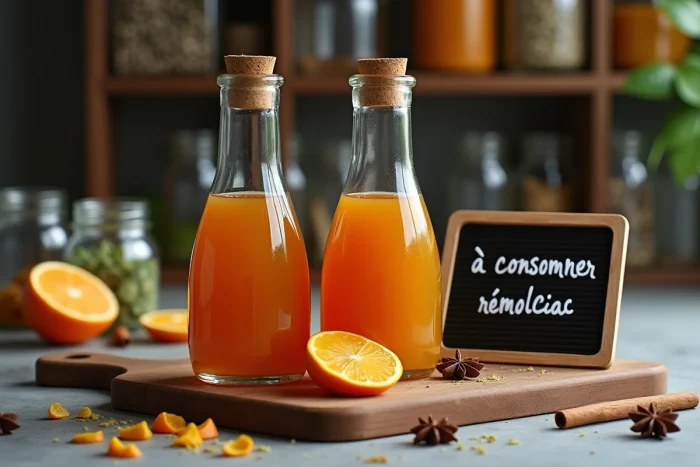
Punch without fresh ingredients (rum, sugar, spices, vanilla): in a well-sealed glass bottle, away from light, this type of punch can last for weeks at room temperature. It is similar to a classic arranged rum. The flavors evolve over time, often for the better.
Punch with pasteurized fruit juice (store-bought orange or pineapple juice): the duration is shorter. A few days in the refrigerator is reasonable. Outside the fridge, limit it to one day, especially if the bottle has been opened and air is circulating.
Punch with fresh cut fruits, coconut milk, or cream: this is the most sensitive category. A few hours at room temperature, no more. In the refrigerator, you can count on one or two days, provided you remove the quickly degrading fruit pieces.
Preparing your punch for a party without an available fridge
When you know in advance that the fridge will be full, adjust the recipe. A punch based on rum, cane syrup, and spices holds up much better than a tropical punch loaded with fresh fruits. You can prepare the alcoholic base several days in advance, store it in sealed glass bottles, and then add juices or cut fruits at the last moment.
This two-step approach protects flavors and food safety. The base infuses quietly, the aromas develop, and the fragile ingredients spend only a few hours out of the cold.
The choice of container also matters. Glass and stainless steel are preferable to plastic, which can alter the taste over time. Sealing the bottles tightly limits oxidation and the entry of contaminants.
Ultimately, the shelf life of homemade punch outside the refrigerator depends almost entirely on its recipe. A dry and spicy punch forgives a lot. A creamy punch or one loaded with fresh fruits forgives nothing. In case of doubt after several hours in the heat, the only good decision remains to empty the bowl and make a fresh one.